Irish National Ambulance Service
2024
Problem
Community First Responders (CFRs) attend accidents and medical emergencies in their local areas, often arriving before ambulances to deliver critical early care.
At the time of the project, CFRs were notified of incidents via a text-message-based dispatch system. While functional, this system required responders to interpret dense messages and send coded replies back to dispatch to confirm status and actions. In high-stress situations, this created unnecessary cognitive load, slowed comprehension, and increased the risk of missed or misinterpreted information.
Challenge
Design and deliver a native iOS and Android app that would:
Reduce cognitive load for CFRs during emergencies
Present complex dispatch data in a clear, glanceable format
Integrate with existing emergency systems and constraints
Improve response efficiency in service of the real end user: the patient
Ultimately, the goal was simple but critical: help responders get to patients faster, with better information.
Solution
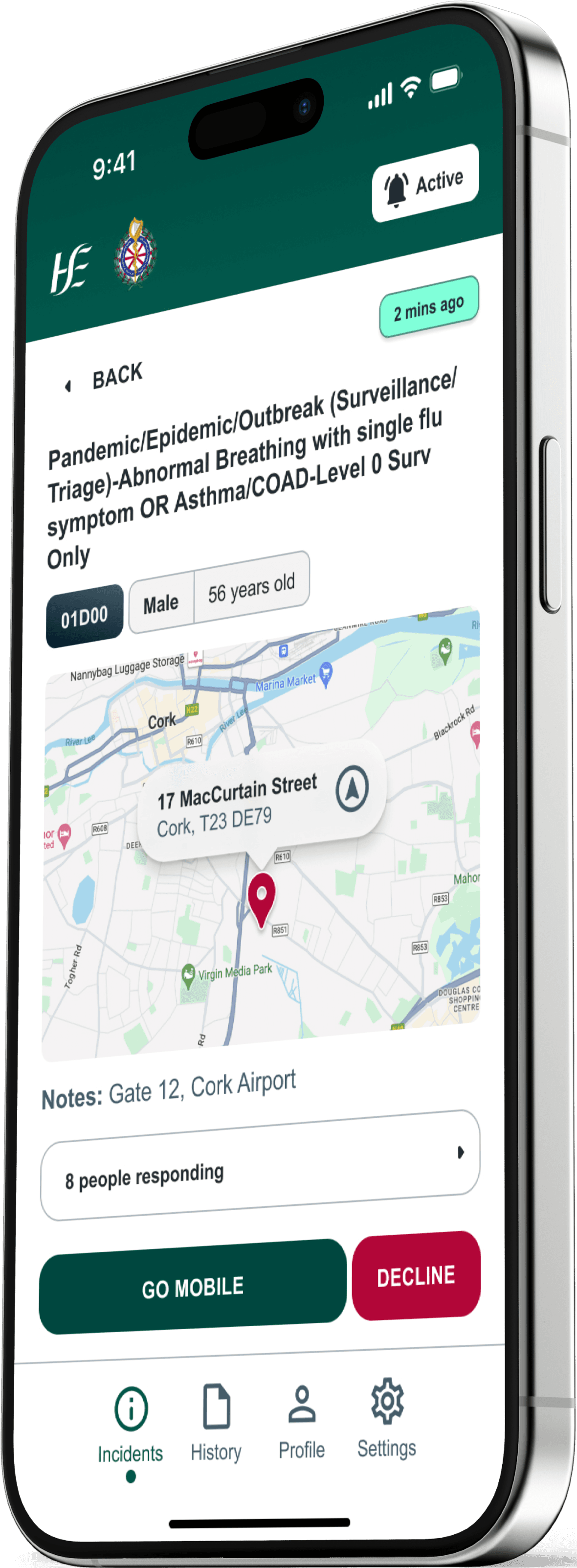
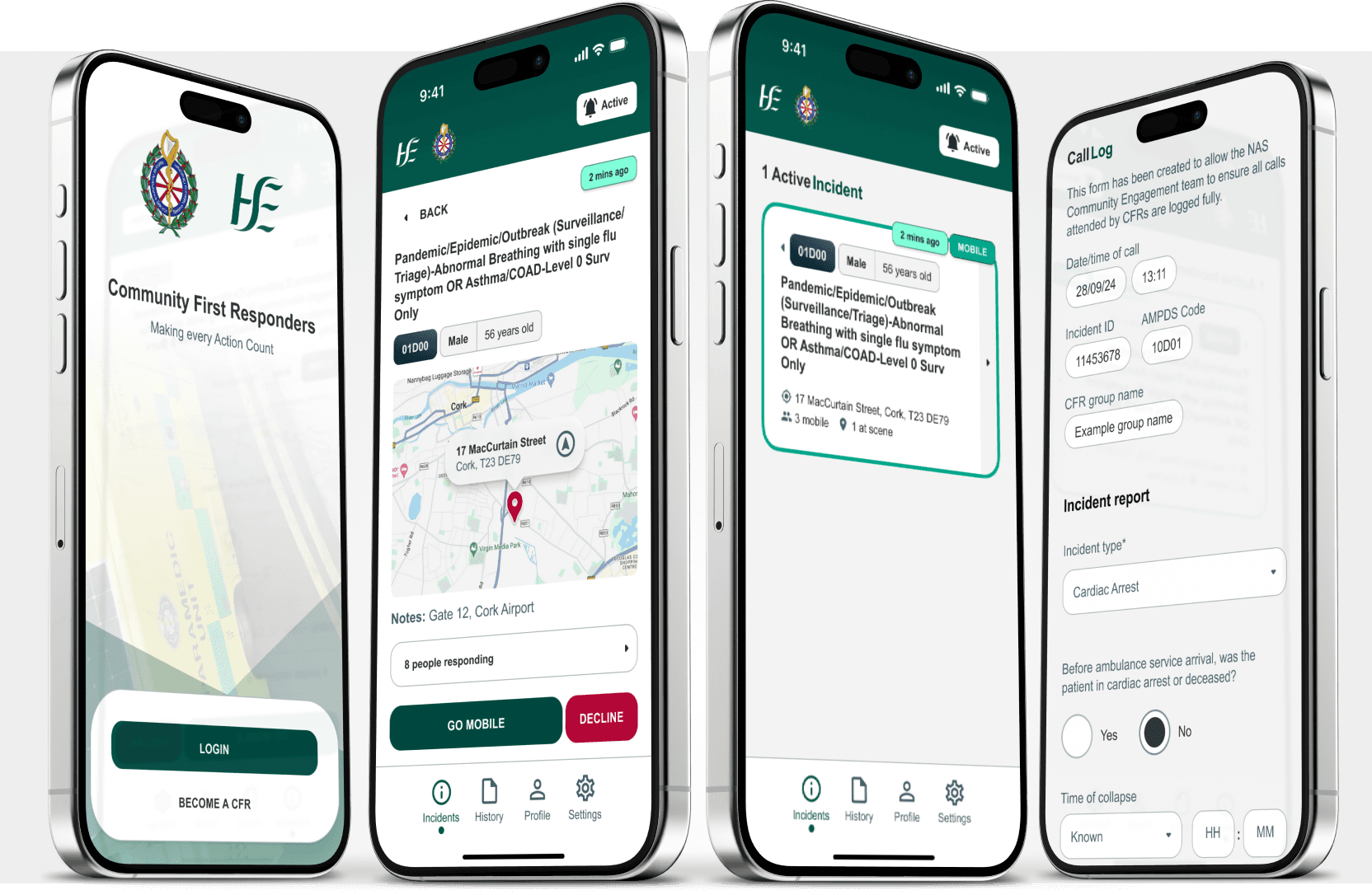
A focused MVP: a simple, direct native app that takes raw dispatch data and presents it as a clear, structured interface designed for high-pressure use.
Because information from dispatch can often be incomplete or minimal, information hierarchy and legibility were core design priorities. Breaking dense messages into clearly separated sections helped responders quickly understand:
What’s happened
Where they’re needed
Who else is responding
What actions are required next
The MVP also introduced several new features to support real-world responder behaviour:
Roaming mode for CFRs travelling outside their usual area
Automatic check-in when arriving on scene
Visibility of other responders (ETA, equipment, and status)
In-app post-incident reporting, removing the need for follow-up texts
Notification snoozing to support availability and fatigue management
Every feature was weighed against one key question: does this reduce friction at the point of use?
The Results
Modernised emergency dispatch
Replaced SMS-based alerts with real-time, app-driven notifications, mapping, and responder status updates.Improved speed to scene
Enabled faster mobilisation of trained volunteers through instant alerts and integrated GPS navigation.Strong early adoption by responders
Rolled out via pilots with CFR groups, expanding toward nationwide use across 4,000+ volunteers.Supports better emergency outcomes
Designed to increase early CPR and defibrillation rates - a key factor in cardiac arrest survival.Recognised as a “game-changer” by NAS/HSE
Publicly endorsed by National Ambulance Service leadership as improving safety, clarity, and coordination.
Community First Responders
Defining scope
We began work in late August, collaborating closely with the client to understand both the operational reality of CFRs and the limitations of the existing text-based system.
Early thinking was intentionally broad, but it quickly became clear that success depended on tight scope control. We needed to define:
What was essential for an MVP
What was technically feasible within the timeline
What could be deferred to future iterations
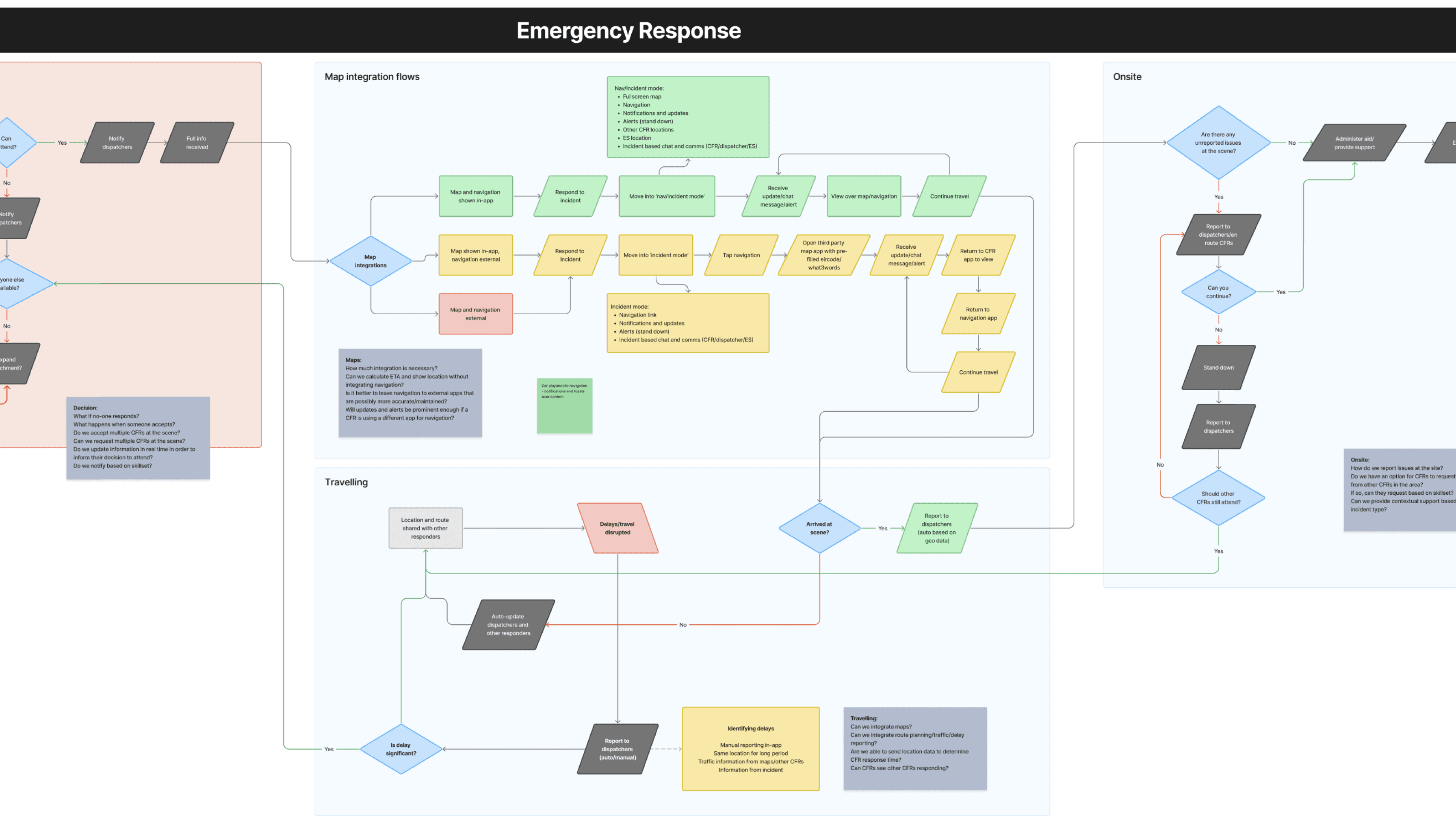
I mapped the end-to-end responder journey - from initial alert to post-incident reporting - highlighting decision points, edge cases, and areas of uncertainty. This helped align the team around a shared understanding of the problem space and exposed where assumptions needed validation.
UX Decisions Under Real-World Constraints
Some decisions required challenging assumptions early.
One key area was map and navigation integration. While initially considered essential, further exploration suggested that in-app navigation could actually increase cognitive load in many situations. CFRs are often responding in familiar areas, and switching between apps or interfaces during high-stress moments can be counterproductive.
The design approach therefore prioritised clarity over completeness, a principle applied throughout the app. This thinking was reinforced through close collaboration with engineering, who were running parallel technical discovery.
Rapid Prototyping & Stakeholder Buy-In
Time was a constant pressure - the original target was an end-of-year delivery - and the client wanted to generate excitement ahead of their annual conference.
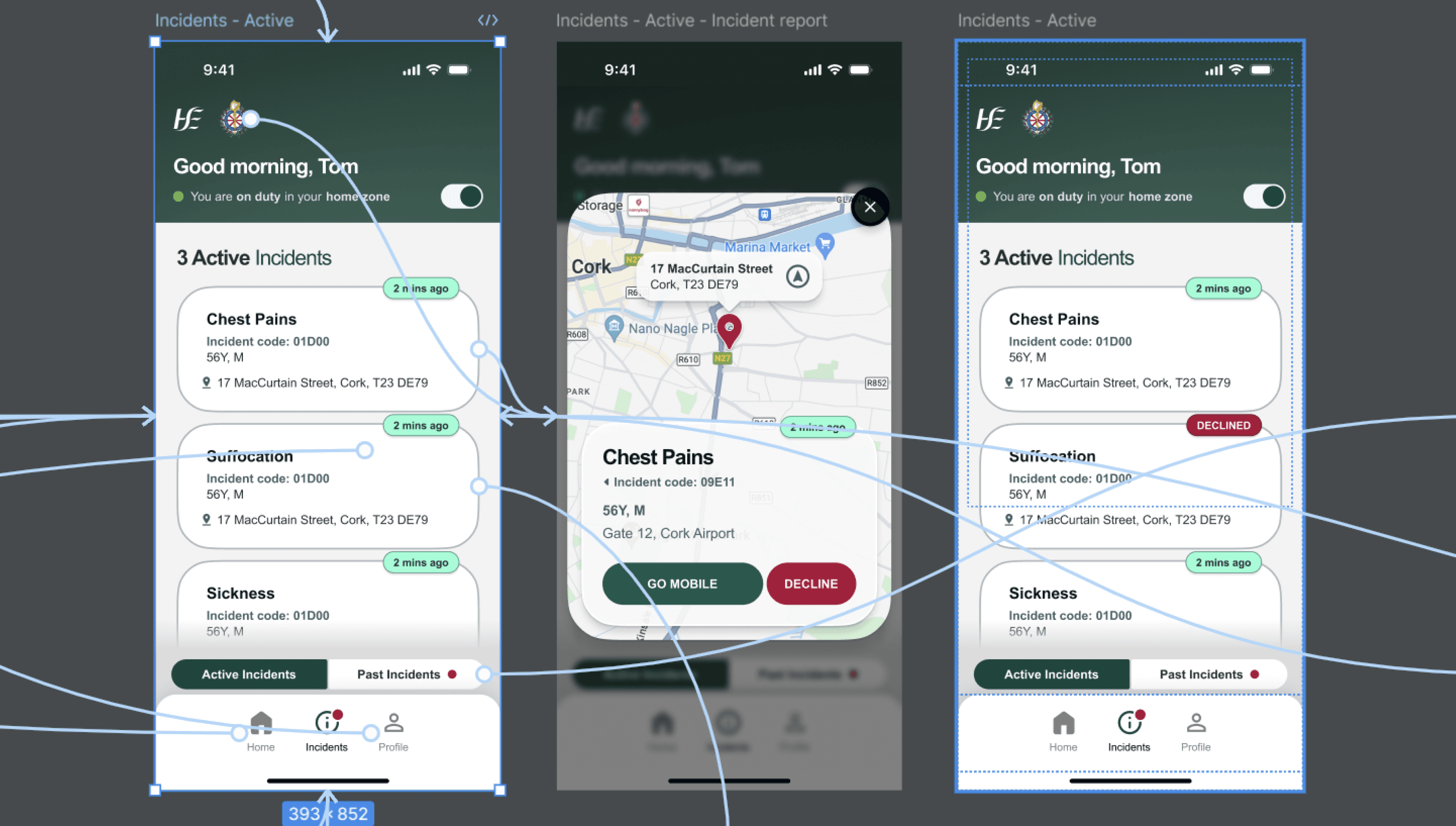
Within roughly three weeks, I produced a fully clickable, high-fidelity prototype that reflected both the intended UX and the visual direction of the final product. This allowed stakeholders and CFRs to experience the app rather than evaluate static concepts.
The prototype proved far more effective than slides in driving understanding and enthusiasm. Feedback was overwhelmingly positive, and early excitement helped position adoption as a core success metric from the outset.
Design System Foundations & Build Support
Following initial validation, I built a baseline component library using Figma variables and interactive components. The goal was to create a system that was:
Easy to maintain and extend
Flexible for future designers joining the project
Clear and practical for engineers to implement
Alongside this, I finalised the UI, resolved remaining edge cases, and ensured the engineering team had the documentation and assets needed as development ramped up - all while accommodating a scope that continued to evolve.
Handover & Next Steps
With design complete, my involvement concluded as engineering moved fully into build.
The MVP is launching first to a test group of responders, with plans for broader national rollout shortly after. From initial discovery to handover, the full design phase took approximately two months, balancing speed with the care required for a mission-critical system.